
5 min to read
Spaceship's Thunderbolt App: Domain-Based Communication for the Decentralized Web
Next-generation voice, video, and chat using your domain name

Thunderbolt has arrived. This next-generation voice, video, and chat messaging app represents a fundamental shift in how we think about digital communication. Instead of relying on phone numbers or email addresses, Thunderbolt uses your domain name as your identity.
A New Paradigm for Digital Identity
Thunderbolt works like many other communication apps, but with one crucial difference: you log in and connect using your domain name, not your phone number. This approach to authentication fundamentally changes the security model for messaging applications.
You connect your domain to Thunderbolt by verifying that you are the domain’s owner. This is done by adding custom (randomly generated by the app) TXT records to the domain’s overall DNS records. On other messaging apps, the user needs to add an email and password, making their account more vulnerable to being hacked if they do not practice proper password hygiene. On Thunderbolt, no password is required.
How Domain-Based Authentication Works
The authentication process leverages DNS verification, a proven method used across the internet for domain ownership validation:
- Generate Verification Record: When you sign up, Thunderbolt generates a unique, random TXT record value.
- Add to DNS: You add this TXT record to your domain’s DNS configuration.
- Verification: Thunderbolt queries your domain’s DNS records to confirm you control the domain.
- Access Granted: Once verified, your domain becomes your identity on the platform.
For a hacker to break into a Thunderbolt account, they would need to compromise the domain owner’s DNS records, a significantly higher barrier than stealing a password. Domain owners can enable DNSSEC to add an additional layer of protection, helping prevent DNS hijacking or spoofing attacks.
Privacy-First Design
Unlike many messaging platforms that store messages on servers indefinitely, Thunderbolt takes a different approach to data handling. Messages are not retained on servers beyond what is necessary for delivery, reducing the risk of data breaches and protecting user privacy.
Thunderbolt also allows you to sync your account and its data across multiple devices, giving you the flexibility to communicate from wherever you are while maintaining consistent access to your conversations.
Universal Domain Support
One of Thunderbolt’s most compelling features is its support for multiple domain types:
- Traditional Domains: Standard domains from registrars like GoDaddy, Namecheap, or Spaceship work seamlessly.
- Handshake Domains: Decentralized top-level domains (TLDs) from the Handshake blockchain are fully supported, enabling censorship-resistant identity.
- ENS Domains: Ethereum Name Service domains bring Web3 identity into the communication space.
This universal compatibility means users can choose their preferred domain system while still communicating with others on the platform, regardless of their domain type.
Security Features
Thunderbolt is built with security as a core principle:
- End-to-End Encryption: All communications are encrypted end-to-end. Only you and your intended recipients can read what is sent. Thunderbolt does not see or retain any message content.
- Access Verification: Connect to Thunderbolt by verifying domain ownership, not through more hackable password logins.
- DNSSEC Protection Ready: For users with DNSSEC-enabled domains, Thunderbolt benefits from the advanced security that ensures DNS responses are authentic and have not been tampered with.
Key Features
Thunderbolt offers a comprehensive communication suite:
- Calls, Messages, and More: Voice calls, video calls, and text messaging are all available in one encrypted space.
- Multi-Device Ready: Use Thunderbolt across multiple devices and connect easily via QR codes for seamless setup.
- Built-in Security: Encryption, access control, and DNSSEC support come enabled by default, no configuration required.
- One Domain, One Hub: Put your domain at the core of your communications with a more personalized and identifiable way to communicate. Streamline everything through one single domain-led hub, and forget juggling random logins, IDs, or phone numbers.
Why Domain-Based Identity Matters
The shift from phone numbers to domain names represents more than just a technical change, it is a philosophical shift toward user sovereignty:
- Ownership: You truly own your domain in a way you never own a phone number. Phone numbers are leased from carriers who can revoke them.
- Portability: Your domain moves with you across carriers, countries, and services.
- Branding: Businesses and individuals can communicate using their brand identity directly.
- Decentralization: With Handshake domains, your identity is not controlled by any central authority.
The Handshake Advantage
For users with Handshake domains, Thunderbolt provides an especially compelling value proposition. Handshake’s decentralized naming system means your identity on Thunderbolt cannot be seized, revoked, or censored by any centralized authority. Combined with Thunderbolt’s end-to-end encryption, this creates a communication channel that is resistant to interference at every layer.
Getting Started and Onboarding Process
Thunderbolt is available on major mobile platforms:
- Google Play Store (For Android)
- Apple App Store (For iOS)
Onboarding Process Example for Handshake name:
(This is an example from an Android phone)
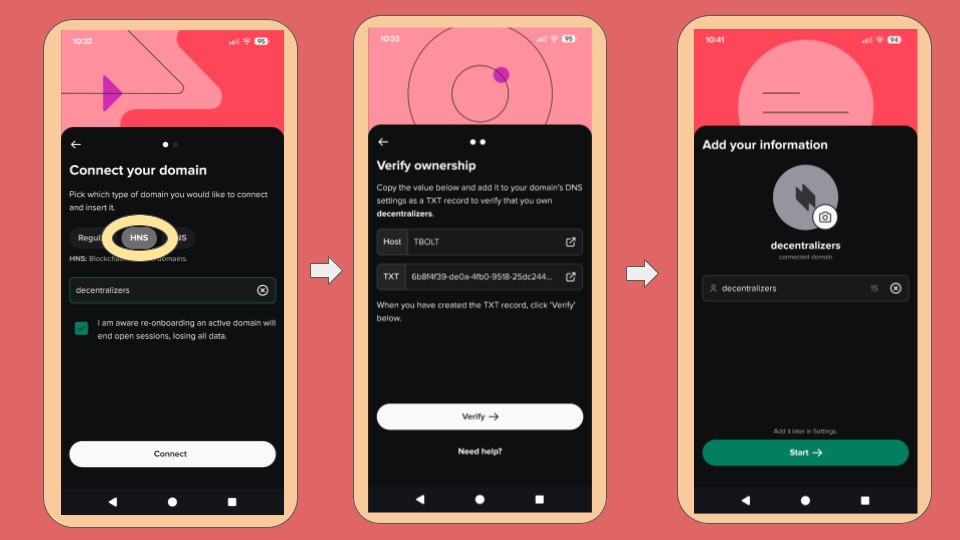 Verifying the decentralizers/ Handshake name
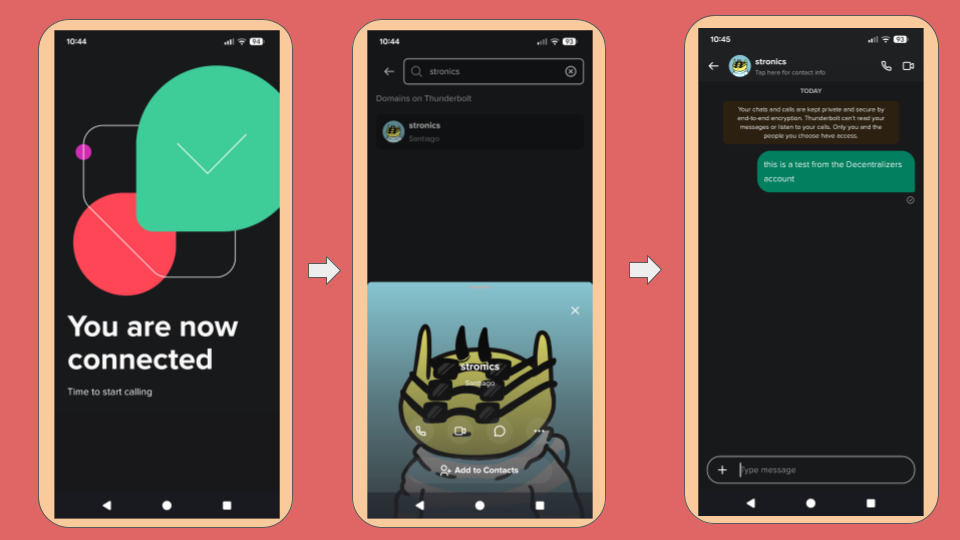 Sending a message through the Thunderbolt app
Conclusion
Thunderbolt represents a significant step forward in how we think about digital communication and identity. By using domain ownership as the foundation for authentication, it eliminates many of the security vulnerabilities inherent in traditional password-based systems. With support for decentralized domains like Handshake and ENS, it aligns with the broader movement toward a more open, user-controlled internet.
Whether you are an individual looking for more secure communication, a business wanting to unify your communications under your brand, or a Web3 enthusiast seeking censorship-resistant messaging, Thunderbolt offers a compelling solution built on the principle that your identity should be truly yours.
References
[1] Thunderbolt by Spaceship - Official Website
[2] Handshake Protocol - Decentralized Naming Protocol
[3] Ethereum Name Service - ENS Domains
[4] DNSSEC - DNS Security Extensions
[5] Spaceship - Domain Registrar


Comments